On Vibe Writing
The Vibes Are Spreading

I hear about ‘vibe coding’ quite a bit these days. The idea is that you describe what you want to the AI, then let it generate all the code. Meanwhile, you, the coder, just get to sit back and vibe. Well this got me thinking. Well can you vibe writing? And how well does this work in an academic context?
How Does One Vibe Write?
I recently decided to try this out for an op-ed I was assigned to write in a journalism class. To begin with, I already knew what I wanted to write about, and had already done substantial research on the topic, specifically for my thesis, which culminated in a 15,000 word report. So, given the main task of translating knowledge between mediums – from an academic report into an op-ed – I thought this might be an ideal time to try out ‘vibe writing’.
Of course, I didn’t immediately send the report off to ChatGPT and submit the result. There was still far too much freedom in what it might output and how well it would communicate what I wanted. I first sat down, and took some more time to flesh out the purpose and some key ideas I wanted the piece to communicate.
For example, I knew the hook and thesis I wanted to communicate. I also had a sense of the narratives that would be most compelling to drive the story forwards. So after spending around 30 minutes jotting all of this down, I finally turned to ChatGPT. “Here’s a report with a lot of information and an outline. Your task is to turn the report into an op-ed following the outline I’m giving you. Make sure to stick to the main ideas from the outline. First, help me revise the outline.”
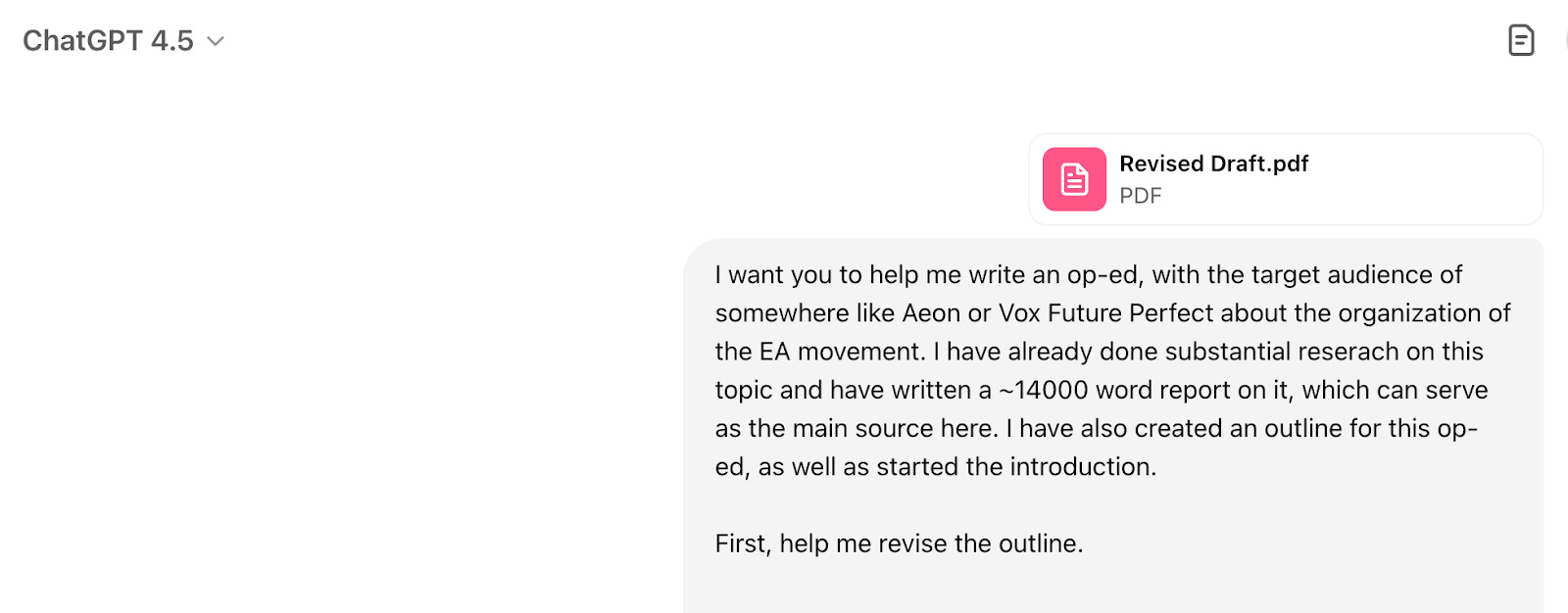
Instead of going straight into writing, I’ve also found it helps to first have the LLM revise the outline to divide the task into more manageable pieces and structure the AI’s thinking. In this case it didn’t change too much. But reading its output, I was at least more confident that we were talking about the same topic.
“Sounds good. Now, turn the outline into a ~1,500 word op-ed, using the report I've given you as your main source.” I turned on deep research, hit send, and sat back to vibe.
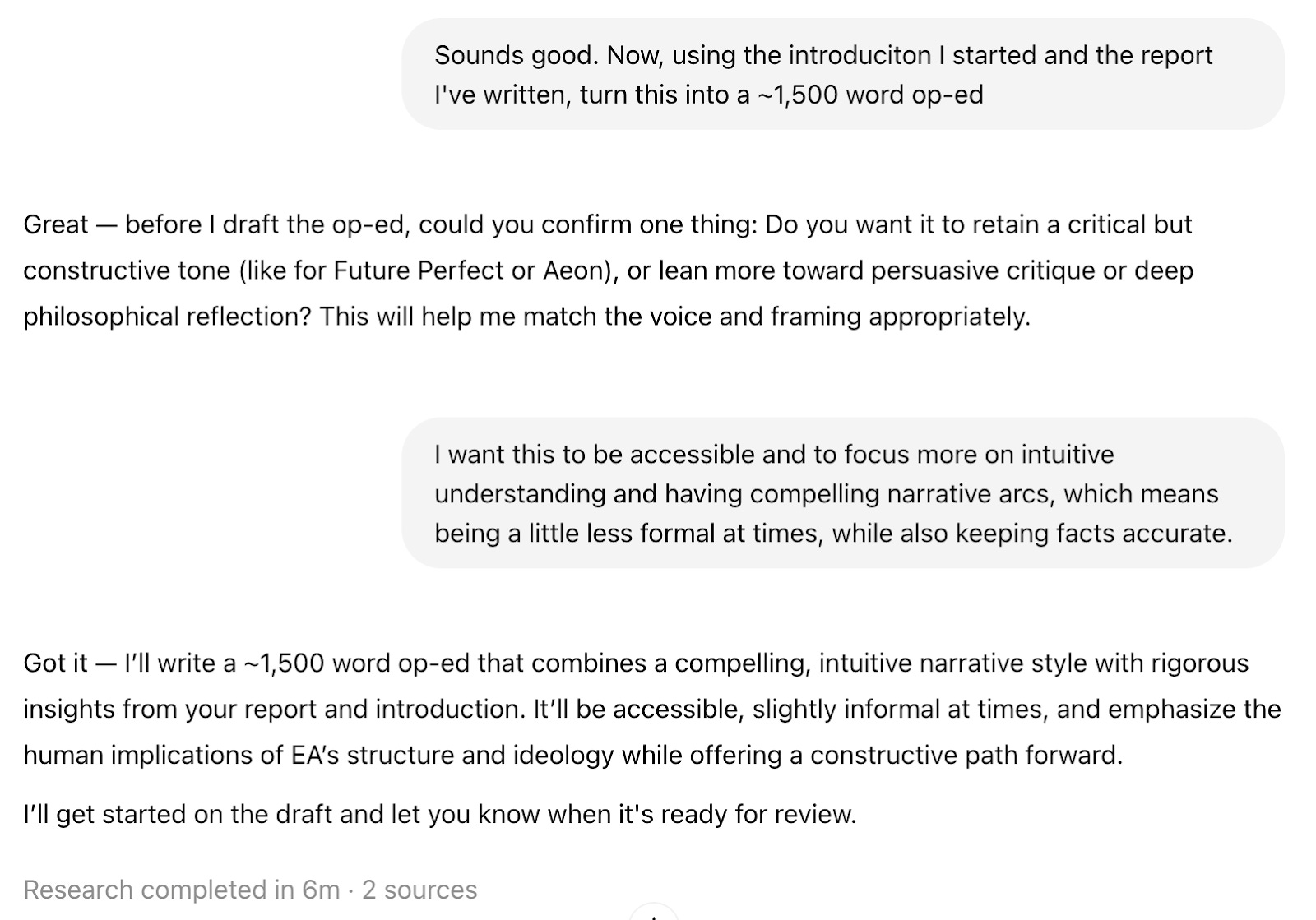
About a music video or two later, it was done. I remember sitting there with my hands on my head, mouth aghast, delighted and shocked. Reading through the piece, the content looked accurate, and captured the crucial elements I wanted to communicate. The LLM even brought out narratives I didn’t think to emphasize myself, despite having worked on the topic for about a year.
It still had flaws though. It was way too long, the introduction paragraph could be more captivating, and it over-fixated on some historic details which distracted from the purpose of the article. I typed all this up and returned to vibing.
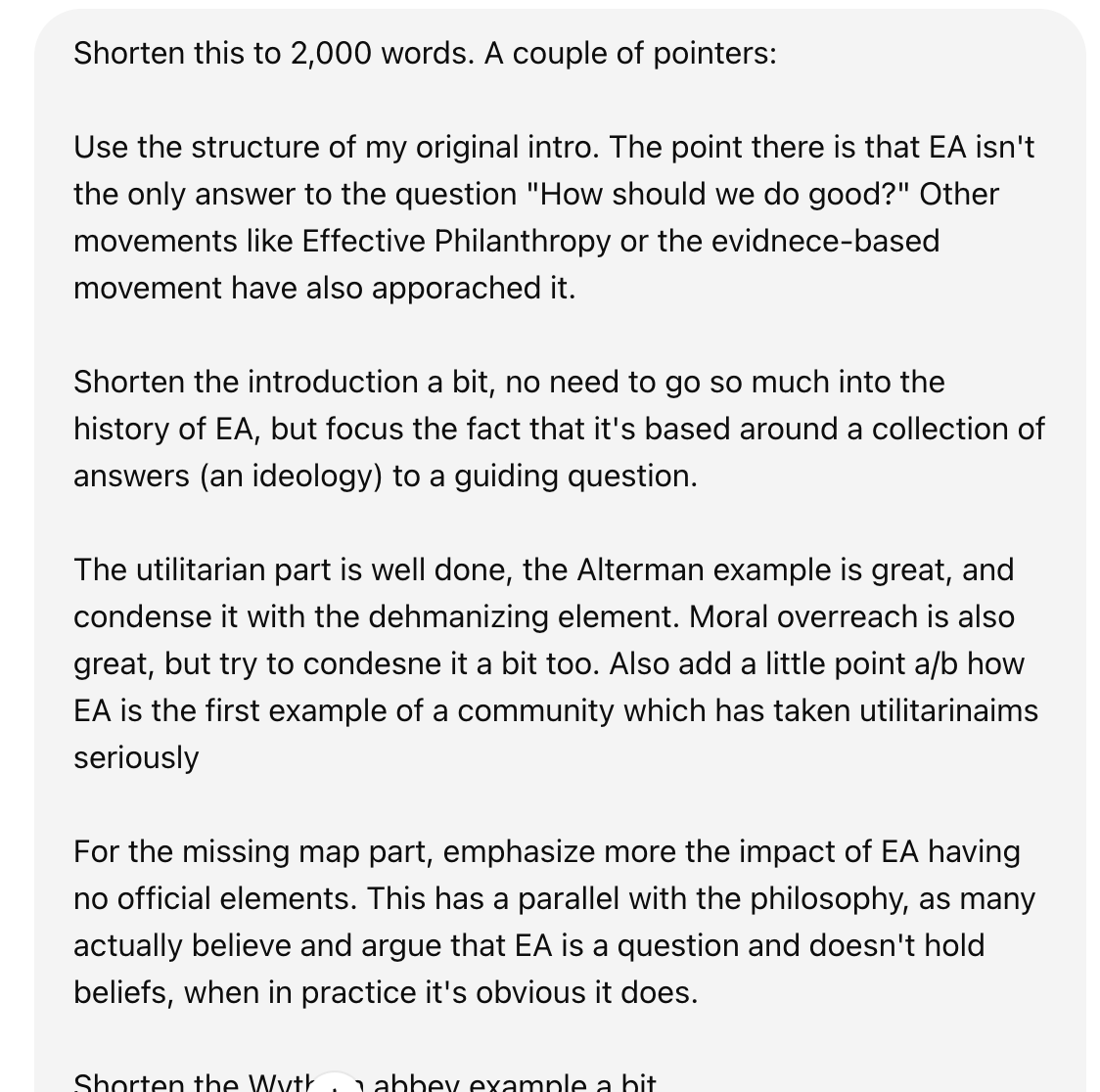
The LLM got back. Content-wise it was certainly better: more concise and pointed. Yet the narrative felt a bit dry. Not a problem. “You are now an expert storyteller and journalist. Revise the writing and composition of this piece. Make sure to align the content with the core ideas from my outline.”
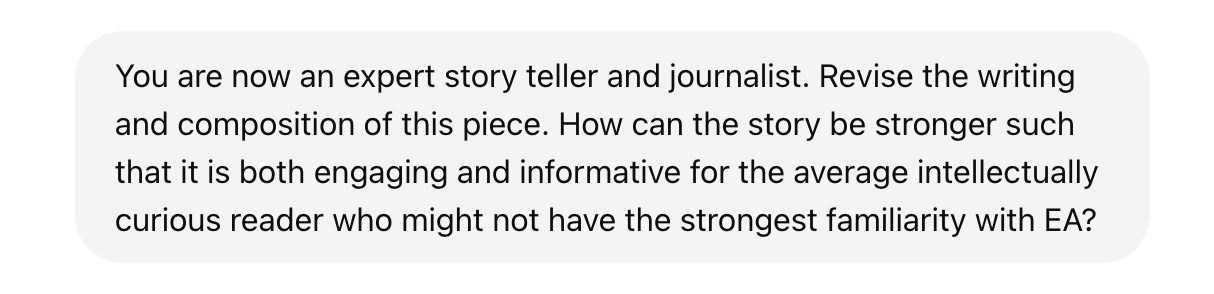
Much better, but too long again. Also the composition was now a bit too flowery, like an LLM wrote it. This went on for a couple more iterations, but at the end, I was fairly happy with the result, and after just an hour, had a very solid first draft to work from. And importantly, this got done significantly faster than if I had written it myself. I spent the next couple of hours polishing, improving the composition here and there, or interchanging sections from different versions to emphasize the right points.
From start to finish, this entire process took about 5 hours (30 minutes creating an outline, 1 hour working/vibing with ChatGPT, and 3.5 hours refining ChatGPT’s output) – perhaps half of the time this would’ve taken me without AI. About 95% of the words in the final version were written by ChatGPT, although often curated by me. Here is the full ChatGPT log. (I also switched over to Gemini at some point to test out Gemini 2.5, which is great and which I now personally prefer over ChatGPT. However Google’s AI Studio won’t let me export my chat log for some reason.)
Is Vibe-Writing the Future of Writing?
With vibe coding, the outcome is binary: the code either does what it’s supposed to, or it doesn’t. This makes vibe-coding very effective, as you either get your desired outcome and can move on, or you just feed your complaint or error message back into the LLM for it to fix it.
On the other hand, writing rarely offers such clear-cut validation. While there are rules for spelling or grammar, it is harder to determine whether a thesis or tone is ‘correct’. For example, given this piece’s goal of exploring the idea of co-writing with an LLM in an academic context, what hook best achieves this purpose? What tone? What structure?
Let an LLM run recursively to generate code that meets a specific goal, and you’ll likely get good results—both the model and the user can easily verify whether the goal has been met. But apply the same recursive process to a writing task, and the results are more mixed: it’s much harder for either the LLM or the user to judge whether the writing truly accomplishes its intended purpose.
For writing tasks, the challenge often lies in defining the goal itself. For example, when reflecting on the op-ed I submitted, I realize I still have difficulty concisely distilling the purpose of that piece. So if even I’m not sure what the purpose of my piece is, how can I expect an LLM to do any better?
Perhaps this is where the future of writing lies, and where education should focus itself: in developing the critical and creative thinking skills to be able to define worthwhile and clear goals, and evaluate how well an output fits that goal. With vibe-writing, the core task of writing is not to write, but to come up with original, creative, and sharp arguments. Words are but a medium to translate ideas from brain to brain.
For vibe-writing to work well, the user’s fingers might not be all that busy, but their mind must still be sharp. Just like an IDE reports errors in code for the LLM to act on, it is the writer’s job to check for errors in the LLM’s written output, ensuring the composition and structure of the piece is aligned with the writer’s goal.
For example, instead of spending 10%, 20%, and 70% of my time on defining and detailing my goal, vibe-writing, and polishing, respectively for the op-ed, I wish I had spent 60%, 10%, and 30% of my time on each task. While the LLM was able to come up with compelling narratives that amazed me, I also lost track of the goal of the piece. However impressive the shot looked, I ended up shooting the ball out of bounds, not into the net.
When Should You Vibe Write?
This also begs the question, for what kinds of tasks should you give AIs significant autonomy over the writing process? For example, for my op-ed I had significant knowledge on the topic and so I was easily able to validate whether its output was accurate or not and ask it to try out different narratives or ideas it hadn’t already presented. I’d certainly be a lot more hesitant doing this on a topic I wasn’t already familiar with.
In this case, my goal was also communication, less so critical thinking. The analysis was already done, and now I just needed to translate it for a different audience. Again, contrast this with a topic where the point of the writing is to develop my thinking on a topic, or one where I describe my personal experience. For example, this piece was written with minimal input from AI.
The Future of Writing
AI writing tools are getting better. Fast. And they'll keep improving, whether we like it or not. This also means that whether we like it or not, vibe-writing or writing with the help of an LLM, is only going to become more common.
As a student, this excites me. I have always loved daydreaming and thinking through hard problems, but the act of writing has always felt a bit daunting to me. For those of us who care about the exploration of new ideas, this new age of writing may prove to be a paradise.
For education, this is a sign that thinking for oneself will become more important than ever. LLMs may make it easier than ever to create and communicate, but that far from guarantees that what we communicate will be interesting or important. In an age of AI, the role of educational institutions should shift towards ensuring students are taught the tools and skills to critically evaluate content for themselves.
The educators and institutions who recognize this shift will thrive. Those that don’t will only fall further behind, only further incentivizing students to cheat and misuse AI to their own and society’s detriment. As education navigates this important time, I can only hope we will make the right decisions. Either way, the vibes are here to stay.
By: Leo Wu